
Power from the Ground Up: The Feet in Weightlifting
May 11, 2026When we analyze movement in Olympic Weightlifting, the conversation usually revolves around bar path, speed under the bar, hip & shoulder mobility, or even pulling mechanics.
But one of the most important pieces of the lift often gets ignored: Your feet! What the heck are they supposed to do?
Ever look at someone's lift, and think their feet are doing SOMETHING "off" that's talking to you but you have no idea how to help, or what is going on in the first place?
Your feet are the foundation for every position in the snatch, clean, and jerk. They influence how you produce force, absorb load, stabilize under the bar, and transfer power from the ground upward. If the foot and ankle are altering this process, you’ll see it manifest in the rest of the lift… sometimes subtly, sometimes dramatically.
Understanding foot mechanics can improve performance, positioning, efficiency, and even reduce unnecessary stress throughout the kinetic chain.
AND – if you have PAIN with the snatch, clean, and jerk... or missing lifts but don’t know what’s going wrong... keep reading, this may apply to you!
The Foot’s Role in Weightlifting
The foot and ankle shift between two important functions: Mobility & Adaptability, and Stability & Force Production.
The foot needs to be able to transition between these states efficiently depending on the phase of the movement.
When a lifter sets up their lift, we cue for the foot to stay flat, with the weight in the mid-foot, not biased toward the heel or the toe. This encourages full foot pressure to push force through the floor.
But when the lifter then extends into triple extension during the pull, then moving the feet to drop down into a squat receiving position (or a split position for the jerk), the role of the foot changes.
To break this down, lets talk about these two phases, to make sense of what they do during these times!
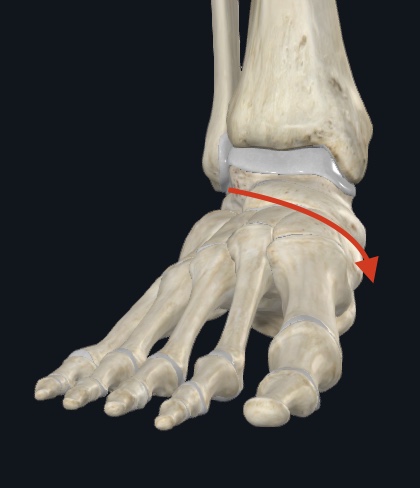
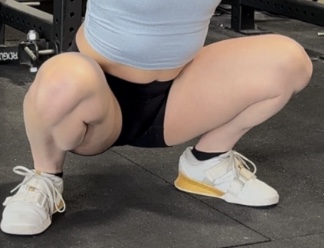
Mobility & Adaptability → Ankle/Foot Pronation
Pronation is a movement at the foot where the the midfoot rolls inward slightly, the arch lowers, and the heel subtly everts outward.
This often gets criticized in fitness spaces, as if pronation is inherently “bad” for you. However, It’s usually when we have too MUCH pronation that is uncontrolled that leads to problems, but in general, the foot SHOULD pronate!
In weightlifting, controlled pronation is normal and necessary.
This allows the foot to:
- Spread and adapt to the floor
- Absorb load during the squat
- Access depth more effectively
- Distribute force through the midfoot
During the descent of a squat or receiving position, the foot needs some adaptability to achieve full and adequate ankle dorsiflexion. This means the ability to bend the knee over the toes to squat down. A completely rigid foot often struggles to absorb force efficiently, as well as hit the squat depth we need!
Pronation is not "bad"... it's NECESSARY. The problem occurs when there is too much of it or when the athlete cannot transition out of it effectively, but in general, a stiff or rigid foot contributes to challenges achieving depth, and may even displace forces up the chain into the knee and hip that feels uncomfortable.
In fact, if one side of the body struggles with this more than the other, we may see weight shifts in the squat or reduced control on the opposite side as the body moves to find movement freedom elsewhere.
Stability & Force Production → Ankle/Foot Supination
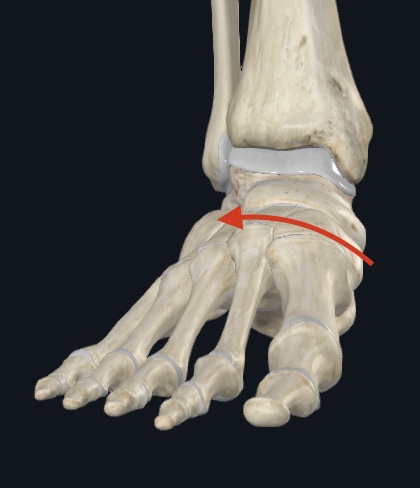
Supination is essentially the opposite strategy. It’s often thought of a “better” foot position, or as if having rigidity and a high arch is “good” for you.
It’s neither good nor bad, and like with anything, too much of anything is too much. – but having the ability to USE these muscles for rigidity and support is essential in weightlifting!
During supination, the arch becomes more rigid, the foot stiffens, and the foot functions like a lever for force production. The foot needs to go from adapting to the floor for adaptability and absorption to producing force into the ground the other direction.
This becomes important when standing from the squat, driving in the jerk, or during the pull when we produce maximal force into the ground!
A stable foot allows force generated by the legs and hips to transfer efficiently into the barbell.
But like anything, too much of anything can be too much. An overly rigid foot may create limited squat depth, poor load distribution, reduced adaptability during the receiving phase, or even excess stiffness through the lower chain.
Like most things in movement, the goal is not living entirely in one strategy — it is the ability to transition between them at the right time.
Force Transfer During Triple Extension
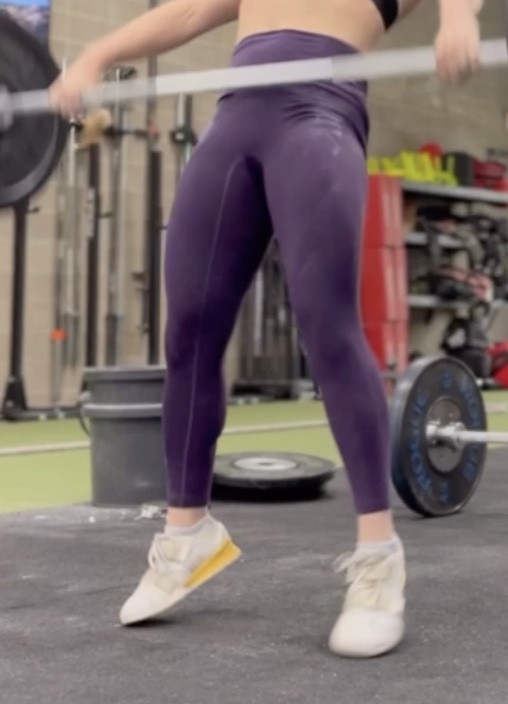
As the lifter moves into triple extension — hips, knees, and ankles extending simultaneously — the foot should transition toward plantarflexion as force is directed vertically into the floor.
At this point, efficient force transfer is essential, meaning that we don’t want to have too much movement into pronation or supination. The ability to remain balanced and push through the neutral part of the ball of the foot allows for best force production and to minimize stress up the chain.
Usually, the foot is biased in a bit of supination, or rigidity for force production, but not too far one way or the other.
If the foot collapses excessively into pronation or stays excessively rigid in supination, force production can become inefficient. This may:
- Reduce connection to the ground too early
- Alter force transfer up the kinetic chain
- Increase stress at the knees, hips, or lower back
- Affect timing and balance in the pull
The Body Will Always Find Motion Somewhere
If the body lacks motion in one area, it will find it somewhere else.
For example, limited ankle dorsiflexion often forces the body to “borrow” motion from neighboring joints or tissues.
That may show up as: excessive midfoot pronation or arch collapse, early heel rise, a forward trunk lean, knee valgus or medial shifting, and altered balance during the catch.
Sometimes the movement faults we see can be arising FROM the foot itself.
What Should the Feet Actually Feel Like During Lifts?
A well-functioning foot in weightlifting should feel:
- connected to the floor through the FULL foot during a squat or set up,
- connected through the ball of the foot during triple extension,
- stable but not rigid,
- adaptive during the receiving phase.
The goal is not gripping the floor aggressively or forcing a perfectly flat arch. Instead, the goal is dynamic control, the ability to move between mobility and stability as the lift demands.
Final Thoughts
The feet are often overlooked in Olympic weightlifting, but they influence nearly everything above them.
A lifter who understands how to use the feet effectively can:
- Improve positional stability
- Transfer force more efficiently
- Reduce compensatory movement patterns
- Improve balance and barbell control
- Create more consistent lifts
In weightlifting, power starts from the ground up. And the feet are where that process begins.
Ready to learn more? Have specific pain problems that are limiting your performance goals? Czarbell is here to help. Reach out at [email protected], or schedule an appointment with me through the main page of this website, to learn more!
